
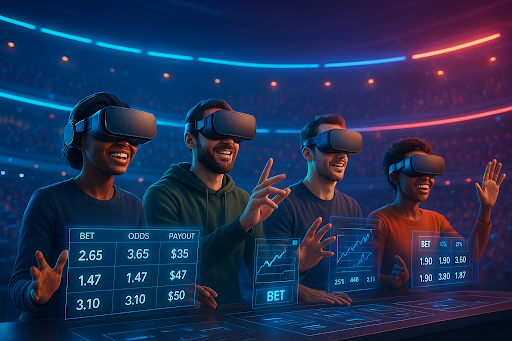
In less than a decade, virtual reality has moved from a novelty to a cornerstone of next-generation entertainment. Headsets have become lighter and more affordable, software has matured, and the concept of “presence” in digital spaces now feels genuinely attainable. While gaming and cinema have led the charge, sports is the domain where VR can knit together live action, data, and community in uniquely compelling ways. For sports bettors, that convergence signals more than just a new interface. It points to a future where wagering shifts from passive screens to immersive participation — where odds, context, and camaraderie are experienced from a virtual seat that’s as engaging as the real thing.
The Evolution of Sports Betting and Technology
Sports betting has always marched alongside technology. From paper slips at the track to desktop sportsbooks and, most recently, mobile-first apps that enable instant, in-play wagering, each phase has simplified access and accelerated decision-making. Live micro-markets, real-time cashout options, and rich data visualisations have already made betting more responsive and analytical. The smartphone transformed the bettor into an always-on participant; streaming layered the match with moment-by-moment opportunities.
VR represents the next major leap. Where mobile flattened the experience into convenience, VR promises depth — presence instead of proximity. The leap is not just a 3D stadium replica or a giant virtual screen; it’s an environment where real-time data, spatial audio, and interactive tools coalesce into something that feels tactile. Bettors can inhabit the context around a match, not just view it. That immersion allows for new forms of engagement: collaborative analysis, social watch parties, and dynamic interfaces that intuitively guide decisions rather than crowd a 2D display with information.
How VR is Enhancing the Sports Betting Experience
Imagine stepping into a virtual skybox that renders a live stadium in front of you, complete with spatial audio that carries the chant of the crowd. On one wall, a dynamic tactics board shows heat maps and player movement as volumetric animations. Below your field of view, odds update as subtle overlays — never intrusive — linked to what you’re watching: an impending corner, a tired left-back, a striker creeping between the lines. You gesture to open a betting panel, slide a stake with your controller, or confirm with a voice command. The experience feels like conversing with the match itself.
Social presence is the other unlock. VR watchrooms can pull in friends or like-minded fans as avatars, adding a clubhouse layer to live betting. Instead of juggling chat windows, everyone shares the same “space.” A companion AI can answer quick questions — “What’s the xG for these sides in the last ten?” — or rewind key sequences as 3D replays that you can walk around. For in-play specialists, micro-bets triggered by highlight detection (a free-kick in a dangerous zone, a substitution pattern, a high-press spell) become less about scrambling on a smartphone and more about calmly interacting with a contextual interface.
Forward-looking betting platforms like 22Bet have been building toward this kind of immersion by investing in richer live markets, real-time data integrations, and UX that can translate to spatial environments. While full VR deployments are still emerging, these foundations matter; they ensure that when immersive watchrooms and interactive overlays become mainstream, the underlying markets, pricing, and latency are ready to meet the moment.
Technological Innovations Driving VR Sports Betting
The hardware jump is significant. Standalone headsets now pack high-resolution displays with wider fields of view, pancake lenses that reduce bulk, and eye tracking that enables foveated rendering — sharpening what you look at while economising compute elsewhere. Haptic controllers (and, increasingly, controller-free hand tracking) make interface gestures natural. Some headsets support mixed reality passthrough, turning your living room into a stadium-inspired lounge with a wall-sized virtual screen, ambient crowd effects, and glanceable odds.
On the software side, three pillars matter: data, intelligence, and latency. Real-time official data feeds inform accurate, up-to-the-second pricing; AI helps surface the most relevant markets, summarise match context, and anticipate what you might want next without clutter. Low-latency streaming — often built on protocols like WebRTC and enhanced by edge computing — keeps motion-to-meaning delays tight, so that what you see and the odds you get feel synchronised. Standards like OpenXR and emerging WebXR pathways allow developers to build immersive interfaces once and deploy across devices, accelerating experimentation. Together, these advances make betting in VR not just possible but pleasant: intuitive, legible, and reliably quick.
Challenges and Future Potential
VR’s promise is substantial, but there are caveats. Headset cost and comfort can be barriers for casual fans; motion sickness and user onboarding remain design challenges. The ecosystem is fragmented, with different platforms and input paradigms. And while immersive spaces heighten engagement, they also demand thoughtful guardrails: clear bankroll visibility, session timers, and one-click limits or cool-offs that travel across devices. Aligning regulations with spatial experiences will be an ongoing effort, especially as social features blur lines between content and commerce.
The trajectory, however, is encouraging. Headsets are getting lighter and cheaper, and mixed reality modes reduce disorientation by anchoring experiences to your physical space. Expect volumetric capture — multi-camera rigs that reconstruct athletes and moments as 3D scenes — to move from replay novelties to standard highlights you can inspect from any angle. AR glasses could extend many of these features to the stadium itself: live win probabilities hovering near the scoreboard, offside lines that animate in sync with officiating, or contextual micro-markets that appear near the corner flag you’re seated beside. We’ll also see smarter “risk HUDs” that translate your exposure and past behaviour into clear, colour-coded prompts. In short, betting shifts from opening an app to inhabiting a fluent environment that blends data, social presence, and ethics by design.